
Thermal transfer ribbons (TTR) are essential to global supply chains, enabling variable data printing, barcode tracking, and industrial product labeling. As the industry demands higher print speeds and sharper resolution, TTR formulations suppliers require raw materials that deliver precise phase transitions, clean release, and thermal stability under varying printhead energy levels.
Pontes Carnauba Biowax supplies high-quality refined carnauba wax suitable for demanding industrial formulations, including TTR applications. Its high purity, consistent quality, and excellent thermal properties help manufacturers achieve reliable print performance and stable production processes.
Beyond Traditional Uses: Expanding Applications of Carnauba Wax
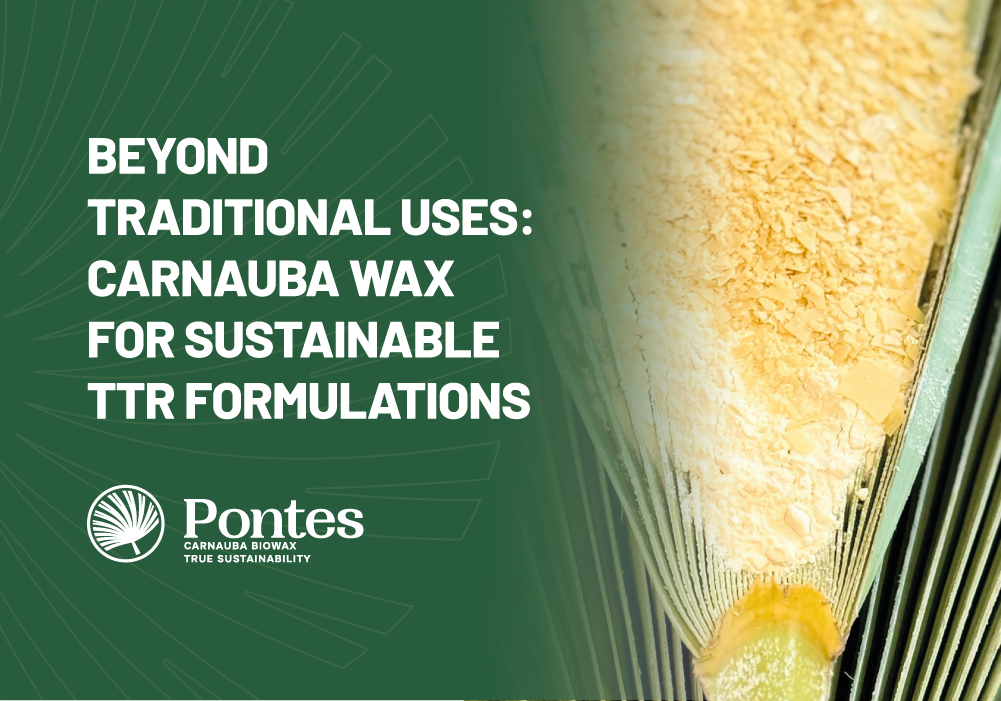
Carnauba wax is obtained from the leaves of Copernicia prunifera, a palm native to northeastern Brazil. Its unique composition provides a high melting point, excellent hardness, and properties that can contribute to abrasion resistance.
Emerging applications include:
• Thermal transfer ribbon (TTR) formulations
• Industrial label coatings
• Flexible packaging inks
• Protective overprint varnishes
• Water-based coatings
• UV-curable coatings
• Specialty release coatings
• Industrial paper coatings
• Functional surface modifiers
Its versatility allows formulators to optimize both mechanical performance and sustainability objectives simultaneously.
Why TTR Formulations Need the best Carnauba Wax
TTR formulations require a carefully balanced combination of waxes, resins, pigments, and additives to achieve reliable print quality and consistent performance. The wax component plays a critical role in controlling melting behavior, ink transfer, release from the PET film, and the durability of the printed image. Using the best wax is essential to ensuring sharp barcodes, clean printing, and stable production across a wide range of printing conditions.
Carnauba wax stands out as one of the highest-performing natural waxes for TTR applications. Its unique properties deliver quality and technical performance, while also offering a sustainable solution. Key Functional Advantages of Carnauba Wax in sustainable TTR formulations:
• High Melting Point (82°C–86°C): Contributes to controlled thermal behavior and consistent transfer performance.
• Exceptional Hardness: Can enhance scratch, abrasion, and rub resistance of the transferred image.
• Sharp Thermal Response: Can support precise image definition and clean print edges.
• Release Performance: Can facilitate efficient transfer of the thermal transfer layer from the PET carrier film.
• Chemical Stability: Supports consistent performance during formulation, processing, and storage.
• Renewable & Bio-Based: Derived from the leaves of the carnauba palm, a renewable plant-based raw material.
Reliable Quality for Global Manufacturers
For TTR formulations and industrial printing systems, wax consistency plays a critical role in print durability, coating performance, and image quality. Even minor variations in purity or physical properties can affect coating uniformity, ink transfer, and overall process efficiency.
Pontes Carnauba Biowax delivers high-quality carnauba wax grades engineered for technical dispersions and solvent-based ink systems, with consistent specifications and rigorous quality control from raw material sourcing through final production. Combining technical performance, traceability, and a reliable international supply chain, Pontes provides global manufacturers with a consistent, high-performance raw material that supports efficient production, consistent printing performance, and evolving sustainability and ESG requirements.
Carnauba Wax: Key Takeaways
• Thermal Performance: Its characteristic melting range and thermal response can support controlled transfer and sharp print definition.
• Release Performance: Can facilitate efficient transfer of the thermal transfer layer from PET carrier films.
• Increased Durability: Exceptional natural hardness protects printed labels against scratches and handling.
• Renewable Feedstock: Its plant-based, renewable origin can support manufacturers seeking to increase the use of bio-based raw materials in their formulations.
Frequently Asked Questions (FAQ)
What is the function of carnauba wax in TTR formulations?
Carnauba wax acts as a functional wax component in TTR formulations, contributing to thermal transfer, release behavior, and the mechanical resistance of the printed image.
How does carnauba wax compare with synthetic waxes in TTR formulations?
Compared with paraffin wax, carnauba wax typically offers a higher melting point and greater hardness. These properties can help enhance coating integrity and thermal behavior in TTR formulations, supporting consistent ink transfer and print quality when properly formulated.
Is carnauba wax compatible with both solvent- and water-based TTR ink systems?
Yes. Refined carnauba wax can be incorporated into both solvent- and water-based TTR formulations. In solvent-based systems, it can be processed with compatible organic solvents, while in water-based systems, it is typically used as an emulsion or fine aqueous dispersion. This versatility makes carnauba wax suitable for a range of TTR coating technologies and formulation requirements.
What makes Pontes Carnauba Biowax a trusted supplier for TTR manufacturers?
Pontes Carnauba Biowax supplies high-quality refined carnauba wax with consistent specifications, high purity, and excellent batch-to-batch uniformity. Backed by rigorous quality control, responsible and traceable sourcing, and a well-established global supply chain, Pontes helps TTR manufacturers maintain stable production processes, consistent print performance, and long-term supply security.
How can natural carnauba wax support sustainability in TTR manufacturing?
Carnauba wax is a renewable, plant-based material obtained from the leaves of the Copernicia prunifera palm, native to northeastern Brazil. Its use can help manufacturers increase the share of renewable, bio-based raw materials in TTR formulations. When responsibly sourced and traceable, carnauba wax can also support broader sustainable sourcing and ESG strategies.