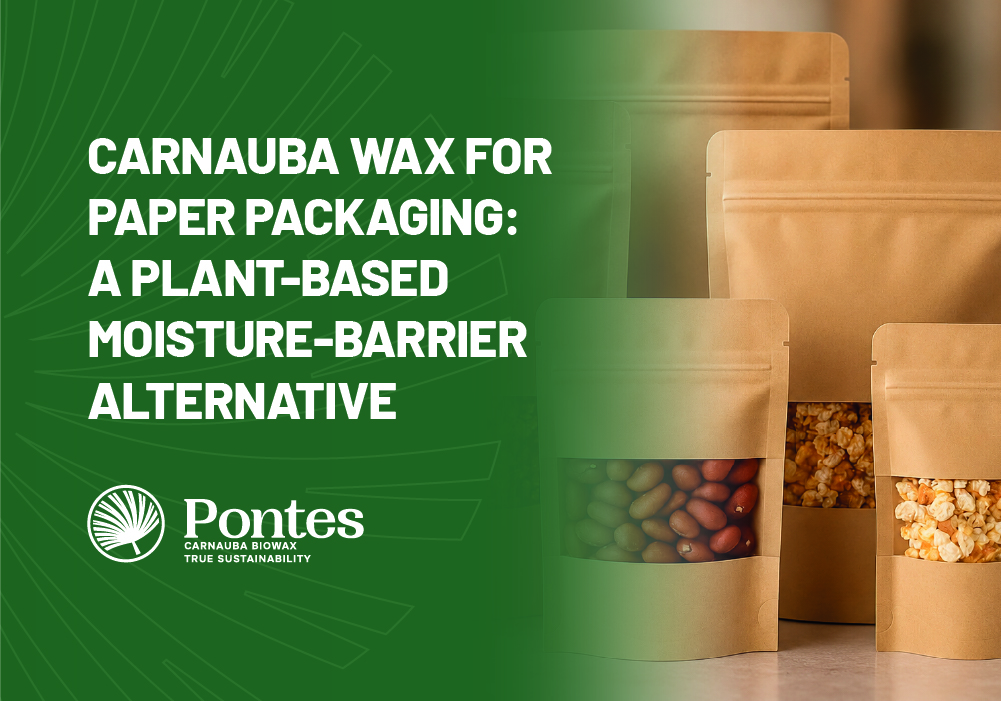
Paper and cardboard packaging need help to keep moisture and grease out, and that help often comes from a layer of polyethylene (PE) or another barrier material. Carnauba wax is a plant-derived ingredient that can add barrier performance to paper without requiring a laminated plastic film. This article looks at how carnauba wax for paper packaging works and what needs to be considered at end of life.
How Carnauba Wax for Paper Packaging Works
Carnauba wax, extracted from the leaves of the carnauba palm (Copernicia prunifera), is naturally hydrophobic. When incorporated into a suitable coating formulation and applied to paper, it can help reduce the passage of liquid water and water vapor through the paper’s fiber structure. The performance of the finished coating depends on the formulation, the paper substrate and the application process.
Pontes produces its carnauba wax under consistent quality control across batches, helping packaging coating formulators work with a reliable ingredient from one shipment to the next. For converters developing paper and fiber-based packaging, Pontes offers:
• A renewable raw material, sourced from the carnauba palm, supporting more sustainable packaging solutions
• A plant-derived ingredient that can biodegrade under appropriate conditions
• A promising foundation for developing repulpable paper coatings
• Commercial grades, including Pontes’ T1, T3, T4C and T4F, that can be evaluated for different coating formulations
The Problem with Plastic Coatings in Paper and Cardboard Packaging
Many moisture-resistant paper and cardboard packages get their barrier properties from a layer of PE or another polymer. These layers can make recycling more complex once the packaging reaches end of life.
Paper mills recover fiber by repulping, breaking the paper back down into a slurry. Depending on the packaging structure and the recycling process, a plastic layer may need to be separated from the recovered fiber. This can add processing steps and reduce the yield of usable fiber. Some coated packages require specialized recycling facilities.
This is one reason regulators, retailers and packaging developers pay close attention to the recyclability of coated paper. Pontes’ carnauba wax offers a plant-based ingredient for converters exploring barrier coatings without a laminated plastic film.
Where Carnauba Wax Coatings Are Used in Paper and Cardboard Packaging
Food-Contact and Food Service Packaging
Wax-coated paper and board show up in food-contact formats where moisture and grease resistance matter more than an airtight oxygen barrier, such as wraps, bags, and food service containers.
For any food-contact use, the wax and the finished packaging need to meet the relevant food-contact material regulations for the destination market, and a supplier operating under a certified food safety system, like Pontes' FSSC 22000-certified production, simplifies that compliance conversation.
E-commerce, Shipping and Industrial Packaging
Outside food contact, wax coatings are used on shipping cartons, void-fill and protective wraps, and labels exposed to humidity or handling in transit, wherever a converter wants moisture resistance without giving up the paper's recyclability at end of life.
Getting From Here to a Packaging Trial
Pontes' export and technical team works from an existing, proven base of applications (automotive, food, cosmetics and packaging) where its grades are already specified, giving converters a track record to build a new packaging application on.
If you're evaluating a plastic-free coating for a paper or cardboard packaging line, contact Pontes' export department at exportdept@pontes.ind.br for technical assistance.
Frequently Asked Questions
What is carnauba wax used for in paper packaging?
It can be incorporated into a coating to add moisture resistance to paper and cardboard. Depending on the formulation, it may also contribute to grease resistance.
Is paper coated with carnauba wax recyclable or repulpable?
It can be. Unlike a laminated plastic film, a carnauba wax coating can be formulated to support repulping. Recyclability depends on the complete packaging structure and the recycling process used.
Is carnauba wax coating biodegradable?
Carnauba wax is a plant-derived material that can biodegrade under appropriate conditions. For a finished coating, biodegradability depends on the full formulation, the surface it is applied to and disposal conditions. Claims about a specific coated product should be supported by testing of that product.
How does carnauba wax compare to a polyethylene (PE) coating for moisture barrier?
Both can help protect paper from moisture. Carnauba wax offers a plant-derived option that can be used without a laminated plastic film. The level of protection and the package’s recyclability depend on the finished coating and packaging design.
Which carnauba wax grade is best for a packaging coating?
It depends on the coating process and whether appearance (color, gloss), performance or cost is the priority. The selected grade should be evaluated in the intended formulation and on the intended paper substrate.
Why choose Pontes as a carnauba wax supplier for packaging applications?
Pontes combines traceable sourcing from Brazil’s Caatinga biome with consistent quality, internationally recognized certifications and a versatile range of carnauba wax grades. Our product carbon footprint data can help customers assess emissions in their Scope 3 inventories and identify reduction opportunities. Alongside technical support for coating development, this makes Pontes a strong partner for converters seeking plant-based packaging solutions.