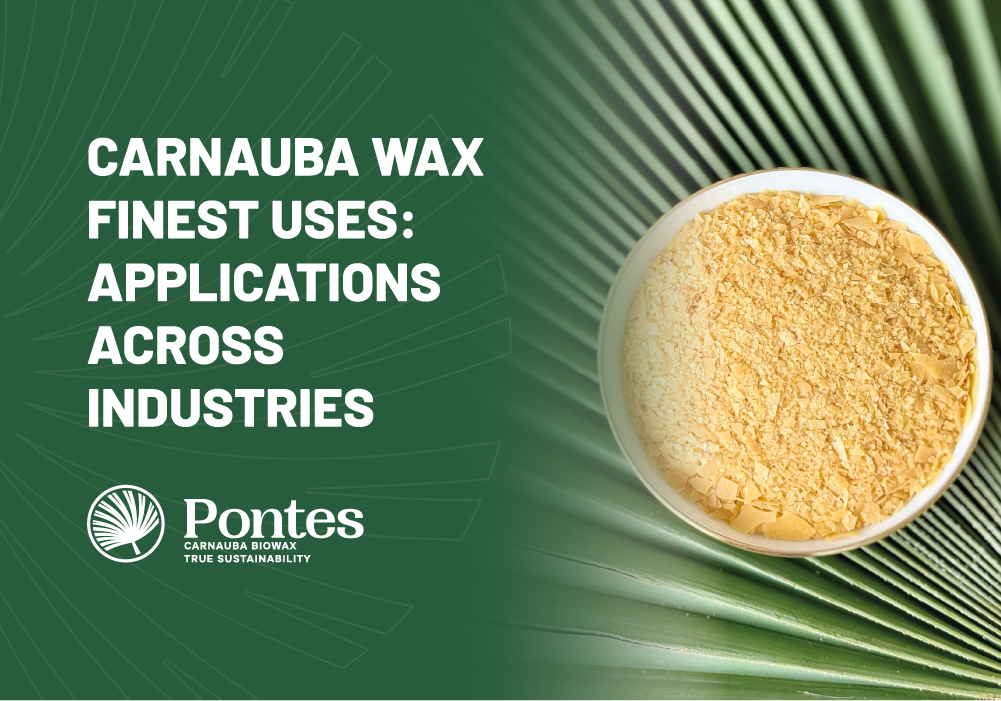
Carnauba wax is a plant-based wax obtained from the leaves of the carnauba palm in northeastern Brazil. Formulators use it to add structure, gloss and a protective finish to products ranging from lipstick and confectionery to pharmaceutical coatings and premium polishes. Its value lies in how these properties can be adapted to very different applications.
What are the carnauba wax finest uses?
Understanding the carnauba wax finest uses starts with looking at the specific function the ingredient can provide within each formulation. Rather than being limited to one product category, carnauba wax can be incorporated into formulations with different technical and aesthetic objectives.
Its versatility makes it relevant to manufacturers working across personal care, food, pharmaceutical and specialty coating applications.
Beauty and personal care: structure with a polished finish
In lipsticks and lip balms, carnauba wax helps give a stick its shape and firmness. In mascaras, eyeliners and other colour cosmetics, formulators use it to adjust texture, consistency and finish. It can also be incorporated into skin care and hair care products where a plant-derived structuring ingredient is desired.
The role of carnauba wax in cosmetics is therefore not limited to simply adding hardness. Depending on the formulation, it can be part of a broader system designed to achieve the desired structure, consistency and surface characteristics of the finished product.
Food: a finishing touch for confectionery and produce
Carnauba wax can be used as a glazing agent to give certain foods a smooth, glossy finish. Applications include confectionery and coatings for selected fruits and other products. The appropriate grade, use level and labelling must be assessed for each product and market.
Among the carnauba wax finest uses, food applications demonstrate how the ingredient can contribute to the visual characteristics of a product. A smooth and glossy surface can be an important part of the desired appearance of certain confectionery and coated food products.
Pharmaceuticals: smooth, consistent coatings
In pharmaceutical manufacturing, carnauba wax can serve as a coating or polishing ingredient for tablets. Its role is specific to the product and manufacturing process, making grade selection and technical evaluation essential.
The application demonstrates the broader versatility of carnauba wax: the same plant-based material can have a very different function depending on the product in which it is incorporated.
Premium polishes and specialty coatings: gloss that performs
Carnauba wax is also used in automotive care, furniture polish and specialty coatings. Formulators value its contribution to surface gloss and finish, often blending it with other ingredients to achieve the application and appearance they want.
These applications are particularly relevant when discussing the carnauba wax finest uses because surface appearance is a central consideration. In automotive care and polishing products, for example, formulators may seek a specific combination of gloss, finish and application characteristics.
Choosing the right carnauba wax
The finest use of carnauba wax is the one matched to the formulation. Colour, purity, particle form, processing conditions, regulatory requirements and desired finish all influence grade selection.
At Pontes Carnauba Biowax, we work with customers across industries to identify the carnauba wax grade suited to their application. From the Brazilian carnauba palm to the finished product, this versatile ingredient connects natural origin with precise formulation needs.
Looking for carnauba wax for your next product? Contact Pontes to discuss your application and technical requirements: exportdept@pontes.ind.br
Frequently asked questions
Where does carnauba wax come from?
Carnauba wax is obtained from the leaves of the carnauba palm, native to northeastern Brazil.
Is carnauba wax used in cosmetics?
Yes. It is used in products such as lipsticks, balms, mascaras and eyeliners, primarily to help adjust structure, texture and finish.
Can carnauba wax be used in food?
Yes, in permitted applications and subject to the rules of the destination market. It is commonly used as a glazing agent.
Which carnauba wax grade should I choose?
The answer depends on the product, process and market. Pontes can help evaluate the relevant technical specifications for a particular application.